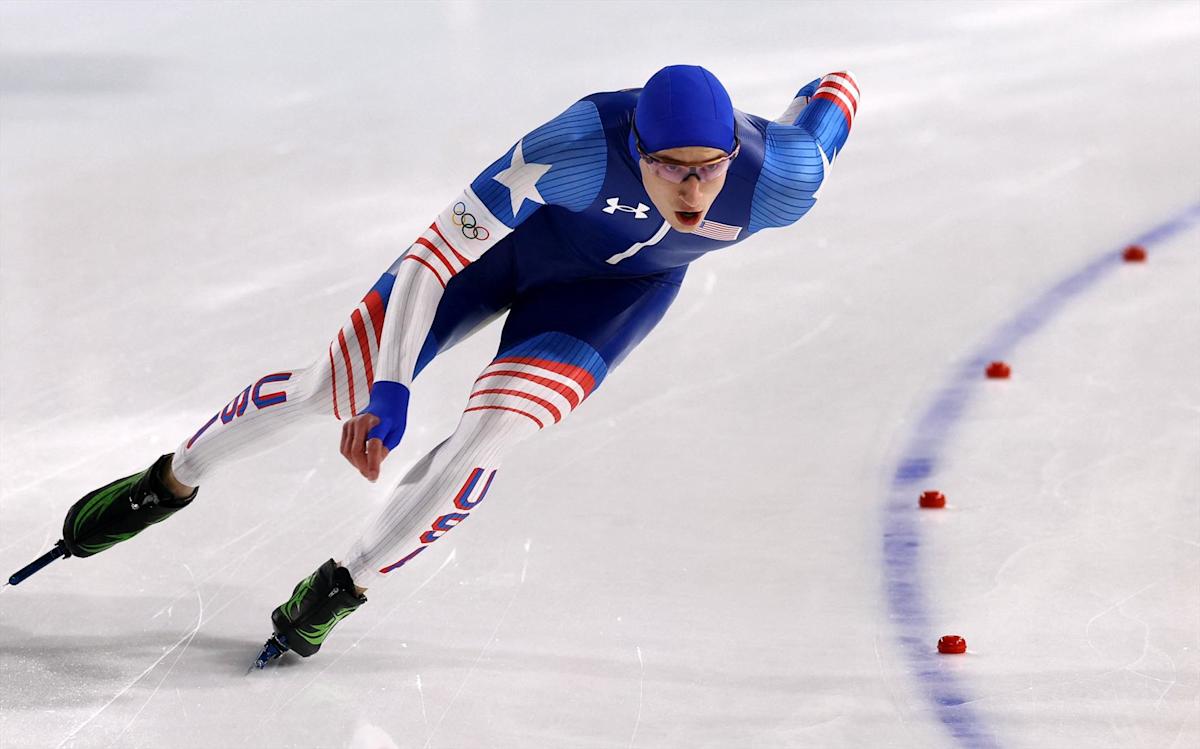
Jordan Stolz has rapidly ascended to the pinnacle of speed skating, captivating fans with his incredible bursts of speed and remarkable endurance. As he continues his chase for Olympic glory, eyeing legendary status alongside figures like Eric Heiden, the question often arises: what fuels this young phenomenon's unparalleled performance? While a potent combination of innate talent, relentless training, and mental fortitude undoubtedly plays a role, a closer look reveals that Jordan Stolz's 6'1" frame is not just a physical characteristic but a critical asset, meticulously leveraged to propel him across the ice at blistering speeds.
At 21 years old, Stolz is already cementing his place in history, setting Olympic records and demonstrating a dominance that belies his age. But it's his physical dimensions – specifically his height and weight – that seasoned observers like retired speed skating legend Shani Davis pinpoint as a foundational advantage. Davis, a four-time Olympic medalist himself, emphatically states, "One of his biggest assets is his (body) structure... He is the right height, he's a great weight." This isn't merely anecdotal; it speaks to the complex biomechanics of elite speed skating and how Stolz's physique seems tailor-made for it.
The Biomechanical Blueprint of a Champion: Jordan Stolz's Height Advantage
When Shani Davis highlights Jordan Stolz's height and weight (listed as 6'1" and approximately 180 pounds) as a significant asset, he's referring to a crucial biomechanical truth in speed skating. A taller athlete, particularly one with long limbs, possesses an inherent advantage in generating power and covering distance on the ice. This translates into several key benefits:
- Extended Stride Length: Longer legs mean Stolz can cover more ice with each powerful push-off. While shorter skaters might rely on a higher stroke rate, a taller skater can achieve comparable, or even superior, speeds with fewer, more potent pushes. This efficiency is critical, especially in longer races like the 1000m and 1500m.
- Increased Leverage: Imagine pushing off the ice with a longer lever. Stolz's leg length provides greater mechanical leverage, allowing him to apply more force and generate more propulsion with each stroke. This maximized force transfer is essential for exploding out of starts and maintaining momentum through turns.
- Optimized Center of Gravity: While a taller stature might initially seem to present challenges for maintaining a low, aerodynamic tuck, when combined with his ideal weight of 180 pounds, Stolz can achieve a stable, powerful posture. This allows him to harness his strength effectively without compromising balance, particularly through the demanding turns.
This "right height, great weight" combination suggests that Jordan Stolz embodies an optimal physiological profile for elite speed skating, allowing him to maximize his power output and efficiency on the ice. His body structure sets the stage for the incredible performances we witness.
Beyond Stature: The Engine and Technique that Elevate the Frame
While Jordan Stolz's height provides a structural advantage, it's how he harnesses this frame with his incredible "wicked engine" and refined technique that truly sets him apart. Five-time Olympic gold medalist Bonnie Blair, who regularly observes Stolz train, praises his ability to execute "a crazy amount of laps" without being pushed by others. This speaks volumes about his cardiovascular capacity and muscular endurance – his "engine" allows him to maintain astonishingly consistent lap times over extended periods.
His impressive 6'1" frame doesn't just grant him powerful pushes; it interacts dynamically with his unique racing style, especially in the turns. Blair highlights Stolz's distinct tempo:
“A lot of athletes, I feel when they go into a turn they're trying to hit it the right way... And Jordan takes more of a quick 1, 2, 3 to get into the turn, and then he just keeps that motor going through the turn and really accelerates coming out."
This "quick 1, 2, 3" tempo, combined with his longer limbs, allows him to maintain a high frequency of powerful, short strokes into the turn, preventing a typical "downshift." His height then helps him generate immense power to accelerate out of the turn, maintaining his speed through sections where others might lose momentum. This was brilliantly demonstrated in his gold-medal winning 1000m race, where he overcame a 0.4-second deficit in the final 400 meters to set an Olympic record of 1:06.28 – a testament to his combined physical prowess and technical mastery.
Coach Bob Corby, who has skated with Eric Heiden and now coaches Stolz, notes that while Heiden was perhaps "even a little bit stronger" and "just so powerful," Jordan possesses "so much speed that he's actually equaling Heiden as far as being a phenomenon in the three shorter distances in 500, 1,000 and 1,500." Stolz's height, coupled with his extraordinary engine and efficient technique, translates into pure, unadulterated speed, rather than just raw power, making him a formidable force.
The Advantage in Every Stroke: Unpacking the 6'1" Leverage
Delving deeper into the practical application of Jordan Stolz's height, his 6'1" frame provides a suite of advantages that collectively contribute to his blistering speed and endurance:
- Optimized Stride Frequency and Efficiency: While longer legs naturally yield a longer stride, Stolz's mastery lies in combining this with an efficient recovery. His powerful engine allows him to maintain a high stride frequency despite his height, meaning he covers vast distances with fewer, yet incredibly potent, pushes. This reduces the overall energy expenditure per meter, contributing to his remarkable endurance.
- Enhanced Power Transfer and Gliding Phase: A longer leg means a longer period of effective push-off against the ice. This extended contact time, coupled with his strength, allows him to transfer maximum force into the ice, resulting in a more powerful push and, crucially, a longer and more efficient gliding phase. Every stroke is maximized for propulsion and minimal drag.
- Stability and Cornering Dynamics: Speed skating corners are perhaps the most technically demanding part of a race. Stolz's height, balanced by his 180 pounds, can be an asset here. A slightly higher center of gravity, when expertly controlled, can be leveraged to create more acute angles and greater centrifugal force through the turns. This allows him to "dig in" more effectively, maintaining his speed and even accelerating where others might falter, as Bonnie Blair observed.
- Aerodynamic Posture: While a larger frame can potentially increase air resistance, elite skaters like Stolz meticulously train to achieve an incredibly low and aerodynamic tuck. His height, surprisingly, can aid in achieving a more streamlined shape by allowing for deeper knee bends and a more elongated, horizontal body position that minimizes frontal drag when properly executed.
It's the synergy of these factors that transforms Jordan Stolz's physical stature from a mere measurement into a dynamic, performance-enhancing asset on the ice.
Optimizing the Optimal: Training and Leveraging a Tall Physique
Possessing an optimal physical structure like Jordan Stolz's height is merely the starting point. The true genius lies in how such a build is trained and leveraged to maximize performance. For a skater of Stolz’s stature, training regimens are meticulously designed to capitalize on every biomechanical advantage while mitigating potential drawbacks. This involves a multi-faceted approach:
- Targeted Strength Training: To fully utilize long levers, immense strength is required in the core, glutes, quadriceps, and hamstrings. Training focuses on explosive power for the push-off and sustained strength for the long glide phases. Exercises like squats, deadlifts, and plyometrics are crucial, tailored to improve power output and muscular endurance without adding unnecessary bulk.
- Precision Technique Drills: Longer limbs require precise control. Coaches work with taller skaters to perfect the deep knee bend, the wide, powerful push-off angle, and the swift, clean recovery. This ensures that every stroke is efficient, minimizing energy waste and maximizing distance covered.
- Flexibility and Mobility: Achieving the incredibly low, aerodynamic tuck and the wide range of motion needed for powerful strokes demands exceptional flexibility. Stretching, yoga, and dynamic mobility exercises are integral to prevent injuries and allow the body to move freely and powerfully.
- Nutritional Strategy: Maintaining his ideal competitive weight of around 180 pounds for his 6'1" frame is paramount. A carefully managed diet supports muscle development, provides sustained energy for rigorous training, and aids in recovery, ensuring optimal power-to-weight ratio.
- Mental Acuity and Adaptability: Learning to control and maneuver a powerful, long frame at high speeds demands incredible body awareness and mental fortitude. Skaters must constantly adapt their technique to changing ice conditions and race dynamics, turning their physical attributes into tactical advantages.
For more in-depth discussions on how specific physical attributes contribute to speed skating success, understanding the nuances of how a taller frame impacts performance is crucial. For a deeper dive into these biomechanical advantages, explore articles like Jordan Stolz Height: Is 6'0" an Edge for Speed Skating? and Jordan Stolz's Ideal Height: A Key Asset for His Success.
In conclusion, Jordan Stolz's 6'1" frame is far more than just a measurement; it is a fundamental aspect of his athletic identity, providing him with significant biomechanical advantages that translate directly into unparalleled speed and efficiency on the ice. While his innate talent, relentless work ethic, "wicked engine," and sophisticated technique are indispensable, his optimal physical structure provides the ideal foundation upon which his legend is built. As he continues his meteoric rise, Jordan Stolz stands as a compelling case study of how the synergy between an athlete's physical attributes and their honed skills can redefine the boundaries of their sport.